
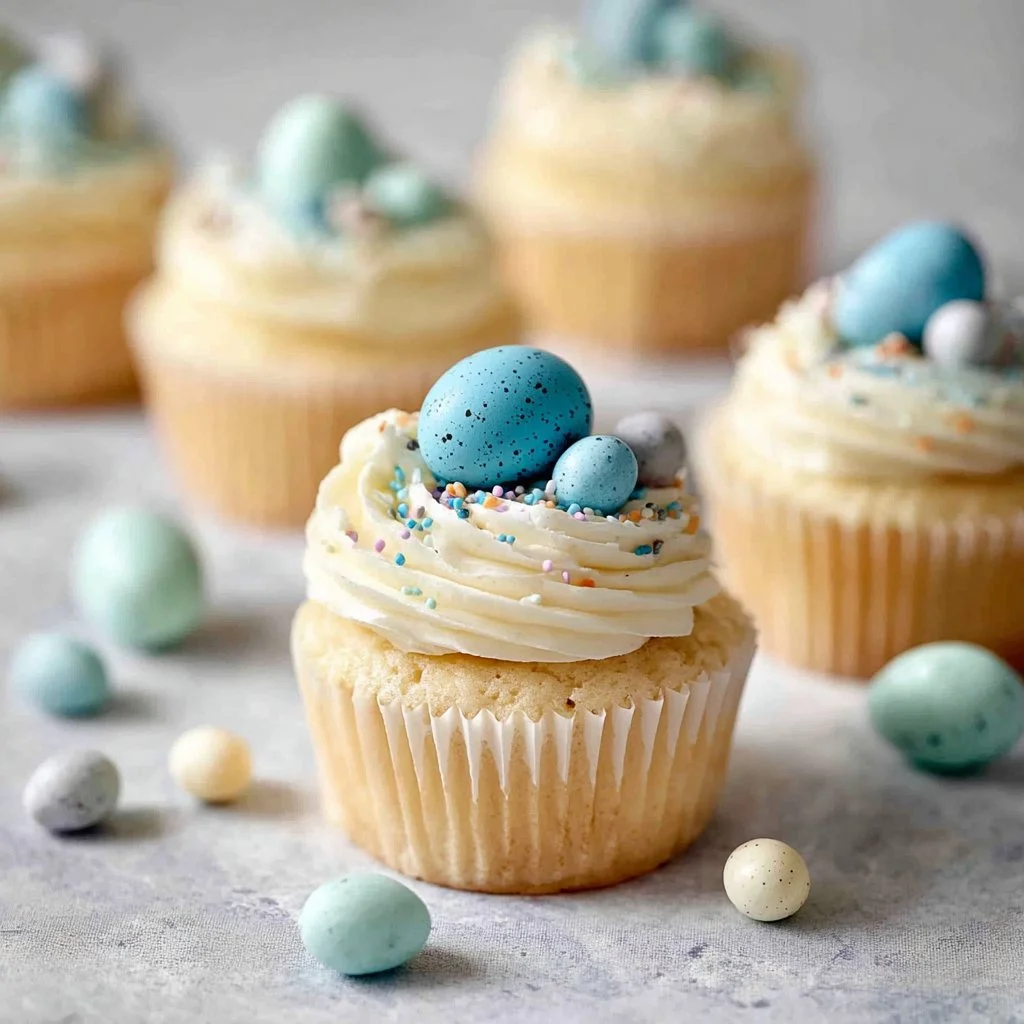
Fresh, speckled, and impossibly cute—the kind of cupcake that steals the show at any Easter table. These Robin’s Egg Easter Cupcakes pair tender vanilla cake with pillowy buttercream and a tiny chocolate egg on top.
They’re simple to make and easy to customize for spring gatherings or weekday treats.
If you’ve baked basic cupcakes before, you’ll pick this up fast. If not, I’ll walk you through the science and the visual cues so they turn out perfect.
For more spring dessert ideas, see a similar speckled egg concept in this recipe: speckled egg Easter cupcakes.
Why You’ll Love This Robin’s Egg Easter Cupcakes
- Cute, festive finish with mini Cadbury eggs that kids adore.
- Light, airy crumb thanks to whipped egg whites.
- Vanilla-forward flavor that pairs with blue-tinted buttercream.
- Slightly tender crumb from cornstarch mixing into the flour.
- Buttery, stable frosting that pipes beautifully and holds eggs.
- Easy to make ahead and freeze.
- Versatile for color or filling swaps.
The taste is classic vanilla with a hint of almond and a crisp chocolate nib from the mini eggs. Texture balances a soft, slightly springy crumb with a dense, smooth buttercream that makes each bite feel decadent but not heavy.
"5 stars — These cupcakes were perfect for our Easter brunch. The cake stayed moist and the frosting piped like a dream. Kids loved the Cadbury eggs!" — Happy Reader
Key Ingredients for Robin’s Egg Easter Cupcakes
All-purpose flour + cornstarch
Flour is the structure of the cupcake; adding cornstarch softens the protein network for a tender, cake-like crumb. Buy a bleached or all-purpose flour you trust for consistent protein levels; cornstarch can be swapped with cake flour if you prefer, but keep measurements adjusted (use 1 1/2 cups cake flour instead of the flour + cornstarch combo).
Egg whites (3, room temperature)
Whipped egg whites introduce lift without extra fat, giving the cupcakes a light, airy texture. Use room-temperature whites for better volume; if you substitute whole eggs, expect a richer, denser cake and reduce the butter slightly to maintain balance.
Salted butter (for cake and frosting)
Salted butter provides flavor depth and a silky mouthfeel in the cake and frosting. If you only have unsalted, add a pinch more salt to the batter and frosting. Choose European-style butter for a richer taste, but standard salted butter works perfectly for this recipe.
Sour cream (1/2 cup, room temperature)
Sour cream adds acidity and moisture, tenderizing the crumb and helping the leaveners react. If substituting, use full-fat Greek yogurt for similar tang and texture; avoid low-fat versions which can dry out the cake.
Full Ingredient List for Robin’s Egg Easter Cupcakes
- 1 1/2 cups all-purpose flour
- 1/4 cup cornstarch
- 1 teaspoon baking powder
- 1/4 teaspoon baking soda
- 1/4 teaspoon salt
- 1/2 cup salted butter (at room temperature)
- 1 cup granulated sugar
- 3 egg whites (at room temperature)
- 3 teaspoons vanilla extract (or vanilla bean paste)
- 1/2 teaspoon almond extract (optional)
- 1/2 cup sour cream (at room temperature)
- 1/2 cup whole milk (at room temperature)
- 1 cup salted butter (at room temperature) — for frosting
- 4 cups powdered sugar — for frosting
- 2-3 Tablespoons heavy cream — for frosting
- 2 teaspoons vanilla extract — for frosting
- 1/2 teaspoon coconut extract (optional) — for frosting
- Pinch of salt — for frosting
- Blue food coloring — for frosting
- 1 Tablespoon cocoa powder — for inside speckle effect (optional)
- 3-4 teaspoons vanilla extract — extra for flavor adjustments
- Cadbury mini eggs — for decorating
Step-by-Step Instructions for Robin’s Egg Easter Cupcakes
Step 1: Make the cupcakes
Preheat the oven to 350°F (175°C) and line a 12-cup muffin tin with liners. Whisk together the flour, cornstarch, baking powder, baking soda, and salt in a bowl until evenly combined.
Cream 1/2 cup salted butter with 1 cup sugar on medium speed until pale and fluffy, about 3–4 minutes. Add 3 room-temperature egg whites one at a time, mixing until incorporated, then beat in 3 teaspoons vanilla and 1/2 teaspoon almond extract if using.
Alternate adding the dry ingredients and the wet (1/2 cup sour cream + 1/2 cup whole milk mixed together), starting and ending with the dry. Mix until just combined; do not overmix.
Scoop into liners about 2/3 full and bake for 18–22 minutes, or until a toothpick inserted in the center comes out with a few moist crumbs. Cool in the pan 5 minutes, then transfer to a rack.
Pro Tip: Visual cue — the tops should be lightly golden, spring back gently to the touch, and the toothpick will come out with just a few moist crumbs.
Step 2: Make the frosting
Beat 1 cup salted butter on medium speed until creamy. Gradually add 4 cups powdered sugar, half-cup by half-cup, scraping the bowl. Add 2–3 tablespoons heavy cream, 2 teaspoons vanilla, 1/2 teaspoon coconut extract if using, and a pinch of salt. Beat on high for 2–3 minutes until light and fluffy.
Tint most of the frosting a pale robin-egg blue with blue food coloring. Reserve 1/2 cup of frosting uncolored or mix a tiny bit of cocoa powder to create subtle speckles for piping or paint-on details.
Pro Tip: Visual cue — frosting should be glossy, hold a soft peak, and pipe smoothly without dragging or breaking.
Step 3: Decorate the cupcakes
Pipe a simple rosette or swirl of blue frosting on each cooled cupcake. Use a food-safe paintbrush and cocoa-mixed frosting to flick tiny speckles on the blue surface for a realistic egg effect. Top each cupcake with a Cadbury mini egg nestled in the center.
Pro Tip: Visual cue — frosting should hold crisp ridges from the piping tip and speckles will be small, irregular brown dots for a natural look.

Expert Tips for Robin’s Egg Easter Cupcakes
- Temperature tip: Always use room-temperature egg whites, butter, milk, and sour cream for better emulsion and lift. Cold ingredients can cause a dense crumb.
- Texture troubleshooting: If cupcakes are gummy, you likely underbaked or overmixed; ensure you stop mixing when dry ingredients are incorporated and test with a toothpick.
- Equipment tip: Use a stand mixer or a handheld mixer with a whisk attachment for creaming and frosting — it builds volume faster and more consistently.
- Common mistake: Over-creaming the butter and sugar can warm the batter; scrape the bowl and pause if it looks oily or overly thin.
- Frosting consistency: Add heavy cream 1/2 tablespoon at a time to thin, or powdered sugar 1/4 cup at a time to thicken until you get a pipeable, stable texture.
- Visual check: Cupcake domes should be even; if they split dramatically, your oven may be too hot or batter overmixed.
- Piping tip: Chill frosting 10 minutes if too soft, and warm slightly if too stiff; both extremes ruin piped detail.
- Make-ahead tip: Bake cupcakes and freeze unfrosted for up to 3 months on a baking sheet, then bag and thaw before frosting for best texture.
For more Easter cookie and candy pairing ideas, try these Cadbury-inspired cookies: Cadbury egg cookies recipe.
Storage & Freezing for Robin’s Egg Easter Cupcakes
Fridge storage: Store frosted cupcakes in an airtight container for up to 3 days. Keep a single layer to avoid smudging the frosting.
Freezer storage: Freeze unfrosted cupcakes cooled completely on a baking sheet for 1–2 hours, then transfer to a freezer-safe bag or container for up to 3 months. For frosted cupcakes, freeze on a tray until firm then wrap individually in plastic wrap and place in a rigid container for up to 1 month.
Thawing: Thaw frozen unfrosted cupcakes at room temperature for 1–2 hours. Thaw frosted cupcakes in the fridge for 1–2 hours until centers are soft, then bring to room temperature for 20 minutes before serving.
Reheating: For a freshly-baked feel, warm an unfrosted cupcake in a 300°F oven for 3–5 minutes. Do not reheat frosted cupcakes in the oven.
For bright seasonal nests and egg ideas that pair well with these cupcakes, see my sugar cookie egg nests: sugar cookie Easter egg nests.
Variations & Substitutions for Robin’s Egg Easter Cupcakes
Lemon-Robin’s Egg: Replace 1 teaspoon vanilla with 1 tablespoon fresh lemon zest and 2 teaspoons lemon juice. The result is a bright citrus cupcake that contrasts nicely with sweet buttercream and adds a fresh spring note.
Chocolate base: Swap 1/4 cup flour for 1/4 cup cocoa powder and reduce sugar by 1–2 tablespoons. You’ll get a tender chocolate cake that pairs wonderfully with a vanilla-blue buttercream and still supports the egg decoration.
Filled cupcakes: After baking, core the center and fill with lemon curd, raspberry jam, or chocolate ganache. Filling adds a surprise burst of flavor and moisture to each bite.
Coconut-almond twist: Use 1/2 teaspoon coconut extract in the frosting and fold 1/4 cup toasted shredded coconut into the batter. This yields a tropical nuance and extra texture that’s lovely with Cadbury eggs.
For more chewy malted cookie bar ideas that pair well with cupcake platters, check this: chewy Easter malted cookie bars.
Frequently Asked Questions About Robin’s Egg Easter Cupcakes
Q: Can I make the batter ahead of time?
A: You can mix the dry and wet components separately up to 24 hours ahead. For best rise, fold whipped egg whites into the batter right before scooping and baking. If you mix the complete batter and refrigerate, let it sit at room temperature 20–30 minutes and expect a slightly different rise.
Q: Why did my cupcakes sink in the middle?
A: Sinking usually indicates underbaking, too much liquid, or a sudden oven temperature drop. Check oven accuracy with a thermometer and bake until a toothpick comes out with a few moist crumbs. Avoid opening the oven door in the first 12 minutes.
Q: How do I get the pale robin’s-egg blue without streaks?
A: Use gel food coloring and add a tiny amount at a time, mixing thoroughly. For uniform color, whip the frosting until smooth after adding color. If streaks remain, let frosting rest for 5–10 minutes and re-whip lightly.
Q: Can I use powdered egg whites instead of fresh?
A: Reconstituted powdered egg whites can work, but fresh room-temperature whites whip to greater volume. If using powdered, follow package rehydration instructions and whip to stiff peaks, then fold gently into the batter.
Q: How many cupcakes does this recipe make?
A: This batter yields about 12 standard cupcakes. For mini cupcakes, reduce baking time to 10–12 minutes and watch closely for doneness.

Final Thoughts on Robin’s Egg Easter Cupcakes
These Robin’s Egg Easter Cupcakes are charming, dependable, and great for feeding a crowd. If you try them, please leave a star rating in the recipe card below and pin this to Pinterest for next spring.
Conclusion: Robin’s Egg Easter Cupcakes
For a similar take with a nest-style presentation, see this variation on the Robins Nest Cupcakes by a trusted blog: Robin Egg Cupcakes Recipe | Tastes of Lizzy T.
For another colorful, family-friendly approach to robin’s egg decoration, Sarah’s Day Off offers creative assembly tips that complement this recipe: Robins Egg Easter Cupcakes – Sarah’s Day Off.
If you want a floral or alternative frosting idea that pairs well with these cupcakes, Ahead of Thyme presents gorgeous buttercream options worth exploring: Robin’s Egg Cupcakes – Ahead of Thyme.