
A playful, chocolatey layer cake speckled like a nest of tiny candy eggs — but made simply at home.
This Mini Egg Speckled Cake is showy enough for Easter yet cozy for any celebration.
It uses pantry-friendly ingredients and a bold purple buttercream for instant visual impact.
Read on for ingredient science, step-by-step photos cues, and pro troubleshooting you can actually use.
Why You’ll Love This Mini Egg Speckled Cake
- Striking seasonal look with minimal decorating skill required.
- Deep chocolate sponge balanced by a sweet, silky lilac buttercream.
- Crunchy Cadbury Mini Eggs add texture contrast and nostalgia.
- Layered format slices cleanly for party service and photo-ready presentation.
- Speckled cocoa technique is quick and avoids messy ganache drips.
The taste is rich chocolate grounded by brown sugar’s molasses warmth; the buttercream is creamy and slightly sweet, cutting through the cocoa for balance. Texture-wise, the sponge should feel tender and moist while still holding up to four layers of buttercream and decoration.
★★★★★ “The prettiest cake I’ve made for Easter — the speckles look professional and the layers stayed perfectly moist. Guests raved!” — Hannah, home baker
Key Ingredients for Mini Egg Speckled Cake
Unsalted butter
Butter provides both fat and structure; using unsalted gives you full control of the salt level. Choose a high-quality European-style butter if you want a richer mouthfeel. If you substitute with margarine or a low-fat spread you’ll lose flavor and the cake may be denser.
Light brown soft sugar
Light brown sugar adds moisture and a subtle caramel note from the molasses, which complements cocoa beautifully. Buy a soft, clumped-free variety and pack it when measuring for consistency. Replacing with white granulated sugar will make the cake less tender and remove that caramel depth.
Medium eggs, room temperature
Eggs act as emulsifiers and leavening in this dense style sponge; room temperature eggs incorporate more evenly, producing a uniform crumb. Use large eggs close to room temp; cold eggs can cause batter to curdle or mix unevenly. For vegan swaps, expect a very different texture — consider aquafaba or commercial egg replacers but adjust leavening.
Self-raising flour
Self-raising flour brings the right lift without measuring baking powder separately, keeping the crumb even and tender. If you only have plain flour, add 1½ teaspoons baking powder per 125 g and ¼ teaspoon salt to approximate it. Overworking substituted flours will make the sponge tough, so fold gently.
Full Ingredient List for Mini Egg Speckled Cake
- CHOCOLATE SPONGE
- 500 g unsalted butter, softened
- 500 g light brown soft sugar
- 9–10 medium eggs, room temperature
- 500 g self-raising flour
- 100 g cocoa powder
- LILAC BUTTERCREAM
- 500 g unsalted butter, room temperature
- 900 g icing sugar, sifted
- 2 teaspoons vanilla extract
- Purple gel food coloring
- DECORATION
- Cadbury Mini Eggs
- 25 g cocoa powder
- 1–2 tablespoons water
Step-by-Step Instructions for Mini Egg Speckled Cake
Step 1: Preheat and prepare tins
Preheat your oven to 170°C. Line two 8-inch deep cake tins with parchment paper and grease the sides lightly so the paper sits flush.
Pro Tip: The oven should feel steadily warm when you open it; tins should be cool to the touch before batter goes in.
Step 2: Cream butter and sugar
Cream 500 g softened unsalted butter with 500 g light brown soft sugar for 3–5 minutes until the mixture is pale and fluffy. Use a stand mixer on medium speed or a handheld whisk, scraping the bowl down once or twice for even aeration.
Pro Tip: The mixture should look noticeably lighter in colour and fluffy when you lift the whisk; a ribbon should fall slowly when you drizzle some from the beater.
Step 3: Add eggs gradually
Add 9–10 room-temperature eggs one at a time, mixing well after each addition so the batter stays emulsified. If the mixture looks slightly curdled, keep beating — it will come together as the eggs are incorporated.
Pro Tip: Batter should look cohesive and glossy after all eggs are added; if it splits, a spoonful of flour can help to rebind.
Step 4: Fold in dry ingredients
Sift and fold in 500 g self-raising flour and 100 g cocoa powder until just combined. Use a rubber spatula and fold with wide strokes to preserve the air you’ve incorporated.
Pro Tip: The batter should be thick but spreadable; no big streaks of flour or pockets of powder should be visible.
Step 5: Divide and bake
Divide the batter evenly between the two prepared tins and smooth the tops. Bake for 50–60 minutes, or until a skewer inserted in the center comes out clean or with a few moist crumbs.
Pro Tip: The tops should spring back gently when pressed and be slightly pulled away from the tin edges.
Step 6: Cool the cakes
Allow cakes to cool in their tins for 10–15 minutes, then turn them out onto a wire rack to cool completely. Cooling fully prevents the buttercream from melting when assembled.
Pro Tip: The sponge should feel cool to the touch in the center before slicing; warm cake will compress and smear buttercream.
Step 7: Prepare the buttercream
Beat 500 g room-temperature unsalted butter for the buttercream for 5 minutes until very pale and fluffy. This creates a stable base for the icing sugar and colouring.
Pro Tip: Butter should look almost white and airy; tiny visible air bubbles are fine.
Step 8: Add icing sugar and flavour
Add 900 g sifted icing sugar in batches, mixing well between additions. Add 2 teaspoons vanilla extract and a small amount of purple gel food coloring until you reach the desired lilac shade.
Pro Tip: Buttercream should be smooth and pipeable, not gritty; if it’s too stiff add a teaspoon of milk at a time.
Step 9: Level and slice layers
Level the cooled cakes with a serrated knife, then slice each cake in half horizontally to create four even layers. Keep the edges neat to make stacking easier.
Pro Tip: Each layer should be roughly the same thickness; use a ruler or cake leveler for precision.
Step 10: Stack with buttercream
Stack the four layers, spreading an even layer of buttercream between each. Apply slightly more buttercream in the center so the layers sit level after stacking.
Pro Tip: When assembled, the cake should feel stable and not wobble when nudged lightly.
Step 11: Apply a crumb coat
Apply a thin crumb coat of buttercream over the stacked cake to trap crumbs. Chill the cake in the fridge for 30 minutes to set this layer.
Pro Tip: The crumb coat should be thin but even; visible crumbs are okay at this stage because they’ll be sealed by the final coat.
Step 12: Final smooth coat
Apply the final smooth coat of buttercream, using a bench scraper and a turntable for a clean finish. Chill the cake again briefly to firm the surface before speckling.
Pro Tip: The final coat should look silky and have clean edges; small air pockets can be smoothed with a hot spatula.
Step 13: Make speckling paste
Mix 25 g cocoa powder with 1–2 tablespoons water to form a thick speckling paste. Adjust water slowly — you want tiny droplets that flick easily, not a thin wash.
Pro Tip: The paste should cling to your brush and form small globules when flicked, not run in streams.
Step 14: Flick speckles onto cake
Hold a small brush over the chilled cake and flick the speckling paste to create random spots across the buttercream. Work from one side so you can control coverage and density.
Pro Tip: The speckles should appear random and varied in size; let the paste dry for a few minutes before moving on.
Step 15: Pipe and decorate
Pipe rosettes or dollops of buttercream around the top edge and place Cadbury Mini Eggs on top and in the center as desired. A mix of sizes looks most natural and festive.
Pro Tip: Piped decorations should hold their shape and not slump; if they do, chill the cake for 10 minutes before piping.
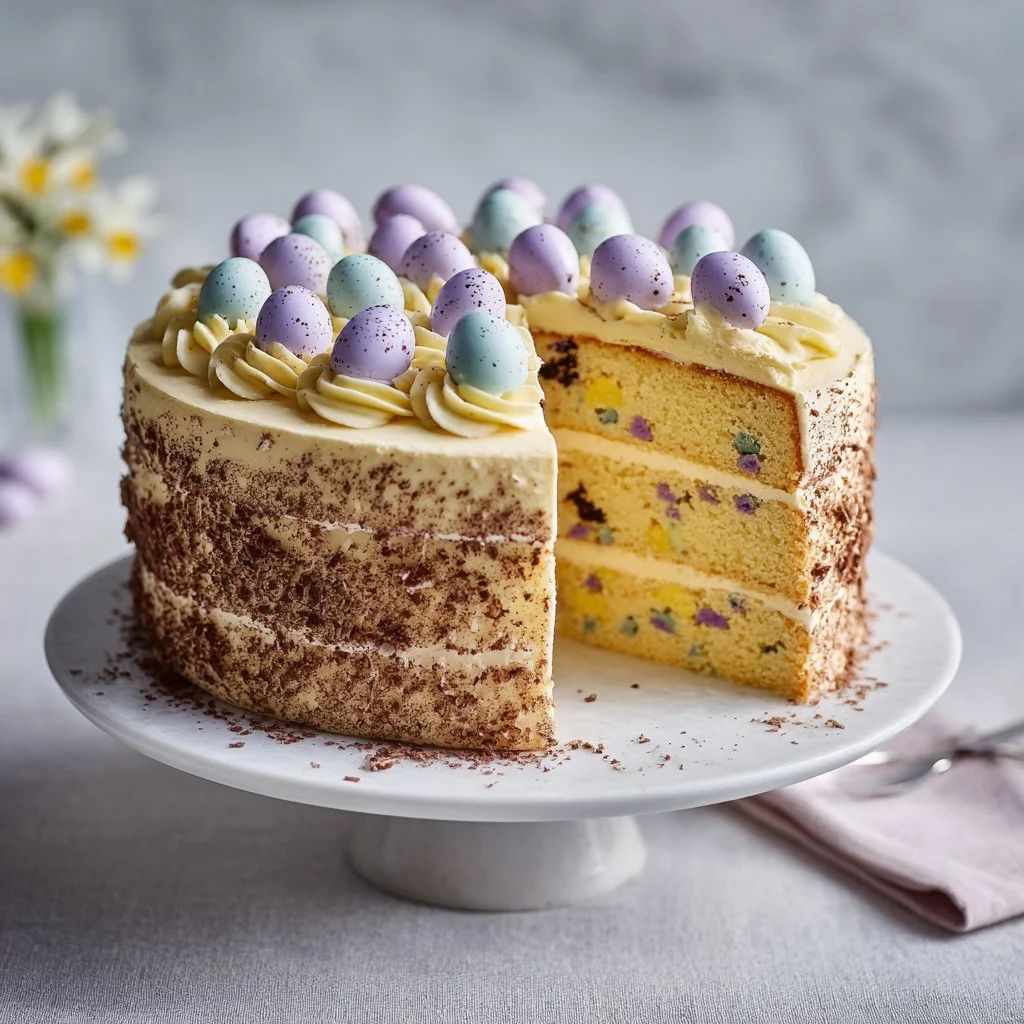
Expert Tips for Mini Egg Speckled Cake
- Temperature tip: Always have eggs and butter at room temperature for smooth emulsion and even rise.
- Oven calibration: Use an oven thermometer; 170°C on the dial can vary by ±10°C and affect bake time.
- Texture troubleshooting: If cake is gummy, bake for an extra 5–10 minutes and test with a skewer; if dry, check your measuring technique and reduce bake time by 5 minutes next time.
- Equipment tip: A turntable and offset spatula make smoothing buttercream far easier and faster.
- Mixing caution: Do not over-fold after adding flour — overmixing develops gluten and leads to a tough crumb.
- Speckle control: Test the cocoa paste on parchment before speckling the cake to perfect your flicking motion and droplet size.
- Common mistakes: Don’t assemble the cake while the layers are warm — this will melt the buttercream and ruin the finish.
- Decoration longevity: Add Mini Eggs just before serving if you expect the cake to sit for a day, as candy can soften in moist refrigeration.
Storage & Freezing for Mini Egg Speckled Cake
Fridge storage: Store the assembled cake in an airtight cake box or covered with a large dome for up to 3–4 days. Keep at 4°C to preserve buttercream texture and freshness.
Freezer storage: Freeze individual slices or the whole cake wrapped tightly in plastic wrap and foil for up to 2 months. For whole cakes, flash-freeze on a tray first to set the buttercream, then wrap.
Thawing: Thaw in the refrigerator overnight for best texture; avoid leaving buttercream at room temperature for more than 2 hours once thawed.
Reheating: Chocolate sponge is best served at room temperature. If you prefer warm slices, microwave a single slice for 8–10 seconds, but beware melting the buttercream.
Variations & Substitutions for Mini Egg Speckled Cake
1) White Chocolate Buttercream swap — Replace the buttercream with white chocolate buttercream by folding 200 g melted, cooled white chocolate into the whipped butter and icing sugar. The cake will taste sweeter and the lilac colour will show through more softly.
2) Gluten-free version — Use a 1:1 gluten-free self-raising flour blend and reduce liquid slightly if the batter seems loose. Texture will be slightly different — often a denser crumb — but the speckle technique and decoration remain the same.
3) Coffee-chocolate twist — Add 1 tablespoon espresso powder dissolved in a little hot water to the sponge batter to deepen the chocolate flavour. This creates a more adult, mocha-style cake that cuts the sweetness of the buttercream.
4) Vegan adaptation — Replace butter with vegan block margarine, use flax or chia egg replacer for the eggs, and swap icing sugar binder to a vegan-styled version. Expect a slightly different crumb and reduced rise; increase binder and egg replacer per packet instructions.
Frequently Asked Questions About Mini Egg Speckled Cake
Q1: How do I prevent my chocolate sponge from sinking in the middle?
A1: Ensure your leavening is correct by using fresh self-raising flour or adding the right amount of baking powder if substituting. Avoid opening the oven in the first 30 minutes; temperature fluctuations can cause collapse. Also, do not overfill tins — fill two-thirds full for even rise.
Q2: Why did my buttercream turn runny after colouring?
A2: Adding too much liquid coloring or working the buttercream for too long in a warm kitchen will soften it. Use gel food coloring which provides intense color with minimal liquid. If it becomes runny, chill for 10–20 minutes and rewhip lightly to restore structure.
Q3: Can I make the speckled effect with cocoa powder only?
A3: Cocoa powder alone will not splatter cleanly; it needs to be mixed with a small amount of water (or alcohol like vodka for faster drying) to form a paste that will flick from a brush. The paste gives defined speckles that adhere to buttercream rather than dusty smudges.
Q4:How far in advance can I assemble this cake?
A4: You can bake the sponge 1–2 days ahead and keep wrapped at room temperature. Assemble and decorate up to 24 hours before serving and store in the fridge. For longer storage, freeze layers and assemble later as needed.
Q5: What’s the best way to slice neat pieces for serving?
A5: Use a long, thin serrated knife and warm it under hot water, then dry before slicing; wipe the knife between each cut. Chill the cake for 15–20 minutes before slicing to firm the buttercream and get cleaner edges.
Final Thoughts on Mini Egg Speckled Cake
This Mini Egg Speckled Cake is equal parts fun and technically satisfying — an accessible showstopper for spring gatherings. If you enjoyed the method, please leave a star rating in the recipe card below and pin this post to Pinterest to save the idea.
For more speckled cake inspiration see the detailed tutorial at Speckled Egg Cake tutorial at Sprinkle of This, a glossy alternative example at Easter Speckled Egg Drip Cake on The Baking Explorer, and an elegant Easter egg cake guide at Easter Egg Cake by Preppy Kitchen.
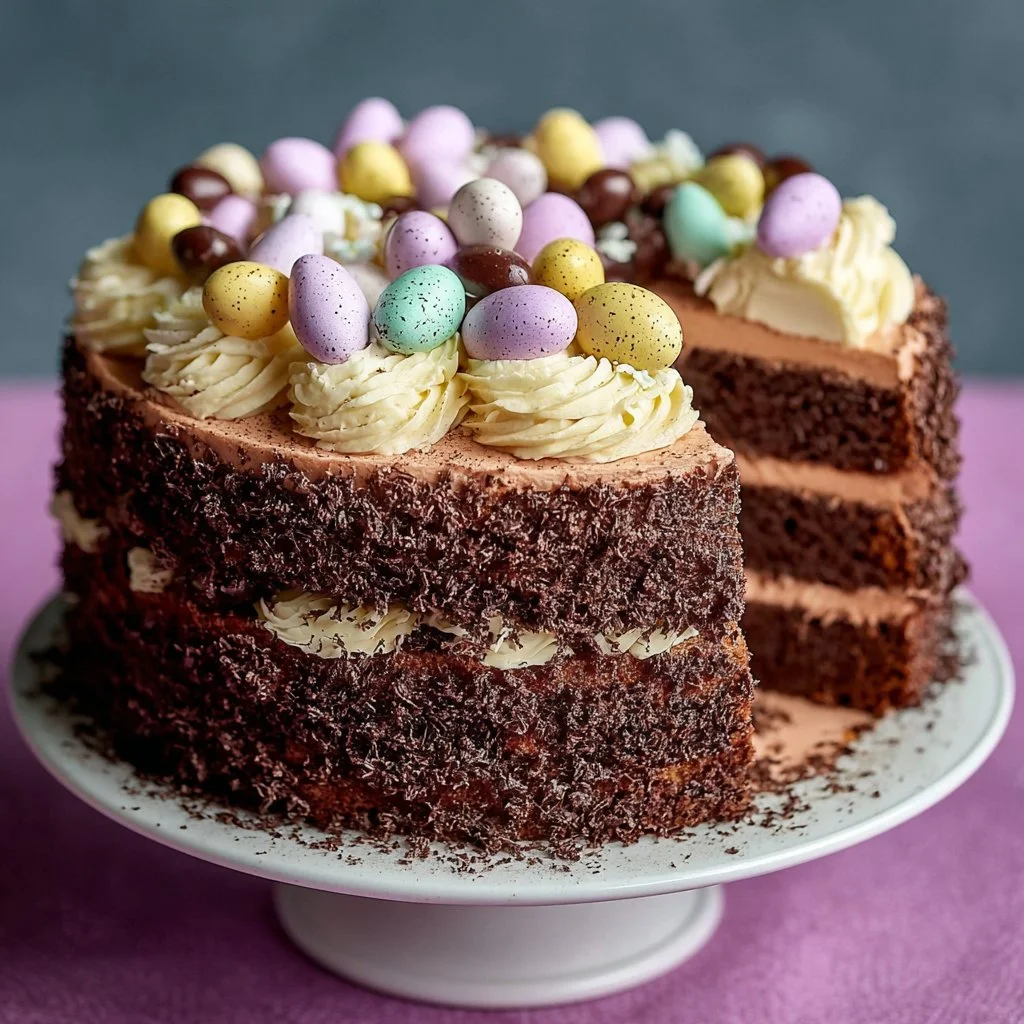
Mini Egg Speckled Cake
Ingredients
Method
- Preheat your oven to 170°C (340°F). Line two 8-inch deep cake tins with parchment paper and grease the sides lightly.
- Cream 500 g softened unsalted butter with 500 g light brown soft sugar for 3-5 minutes until pale and fluffy.
- Add 9-10 room temperature eggs one at a time, mixing well after each addition.
- Sift and fold in 500 g self-raising flour and 100 g cocoa powder until just combined.
- Divide the batter evenly between the two prepared tins and bake for 50-60 minutes.
- Allow cakes to cool in their tins for 10-15 minutes, then transfer to wire racks to cool completely.
- Beat 500 g room temperature unsalted butter until very pale and fluffy. Gradually add 900 g sifted icing sugar, mixing well.
- Add 2 teaspoons vanilla extract and purple gel food coloring until desired shade is reached.
- Level and slice the cooled cakes horizontally to create four even layers.
- Stack the layers with buttercream between each layer and apply a thin crumb coat over the entire cake.
- Chill the cake for 30 minutes, then apply a final smooth coat of buttercream.
- Make speckling paste by mixing 25 g cocoa powder with 1-2 tablespoons water and flick onto the cake.
- Decorate with piped buttercream and Cadbury Mini Eggs.