
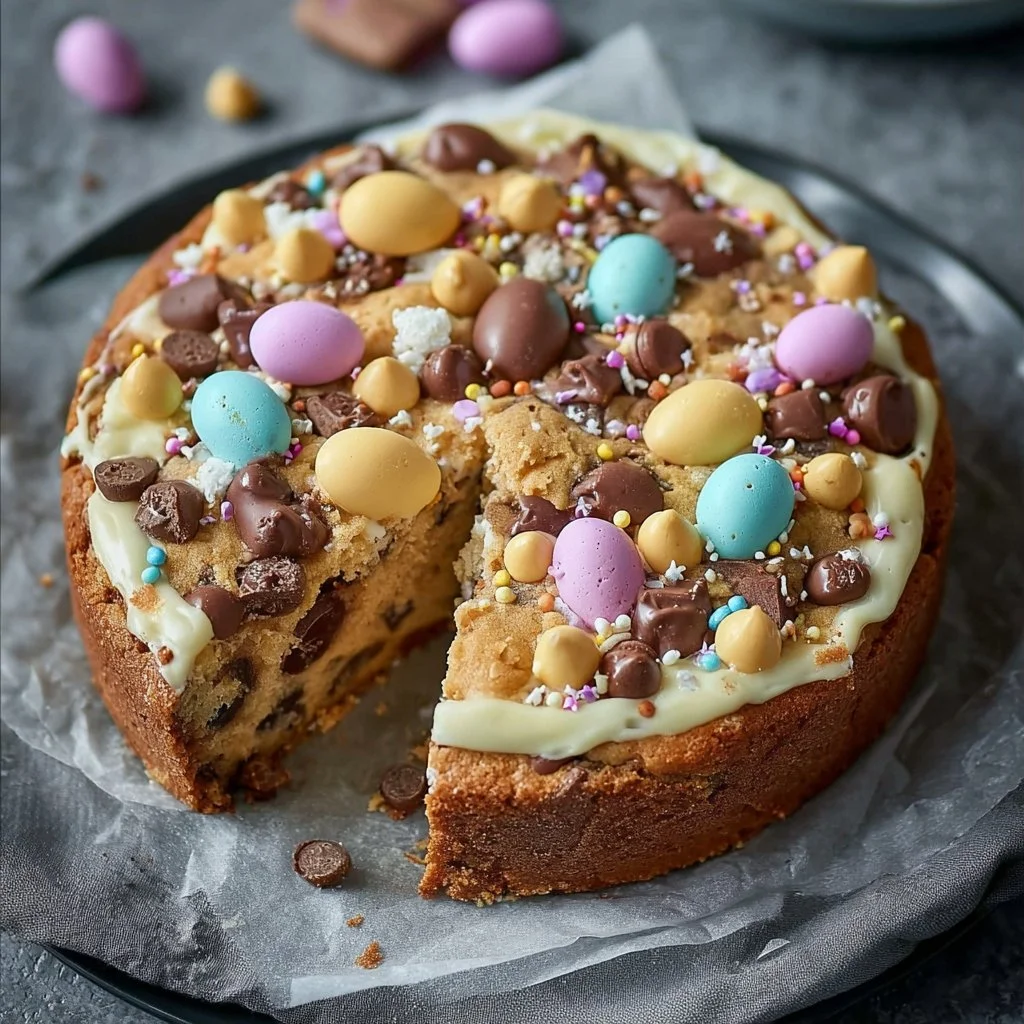
A soft, giant chocolate cookie studded with Easter candies is the easiest showstopper for spring gatherings.
It’s fast to make, fun to decorate, and loved by kids and adults alike.
This recipe turns familiar cookie dough into a cake-sized treat ready for sharing.
No complicated layers — just press, bake, chill, and decorate.
For allergen notes and site baking standards, see our cookie policy and baking notes.
Why You’ll Love This Easter Chocolate Cookie Cake
- Crowd-pleasing giant cookie that feeds a group easily.
- Brown-sugary chew with crisp edges and a tender center.
- Uses simple pantry ingredients with seasonal candy flair.
- Quick assembly — perfect for last-minute celebrations.
- Fun to decorate with kids using extra chocolates and sprinkles.
- Single-pan bake means fewer dishes and fast cleanup.
The flavor blends caramel-like brown sugar, deep-melted milk chocolate, and pockets of seasonal candy that add bursts of color and texture.
Texture is key: the edges should be crisp and slightly chewy, while the center remains soft and sliceable like a cake.
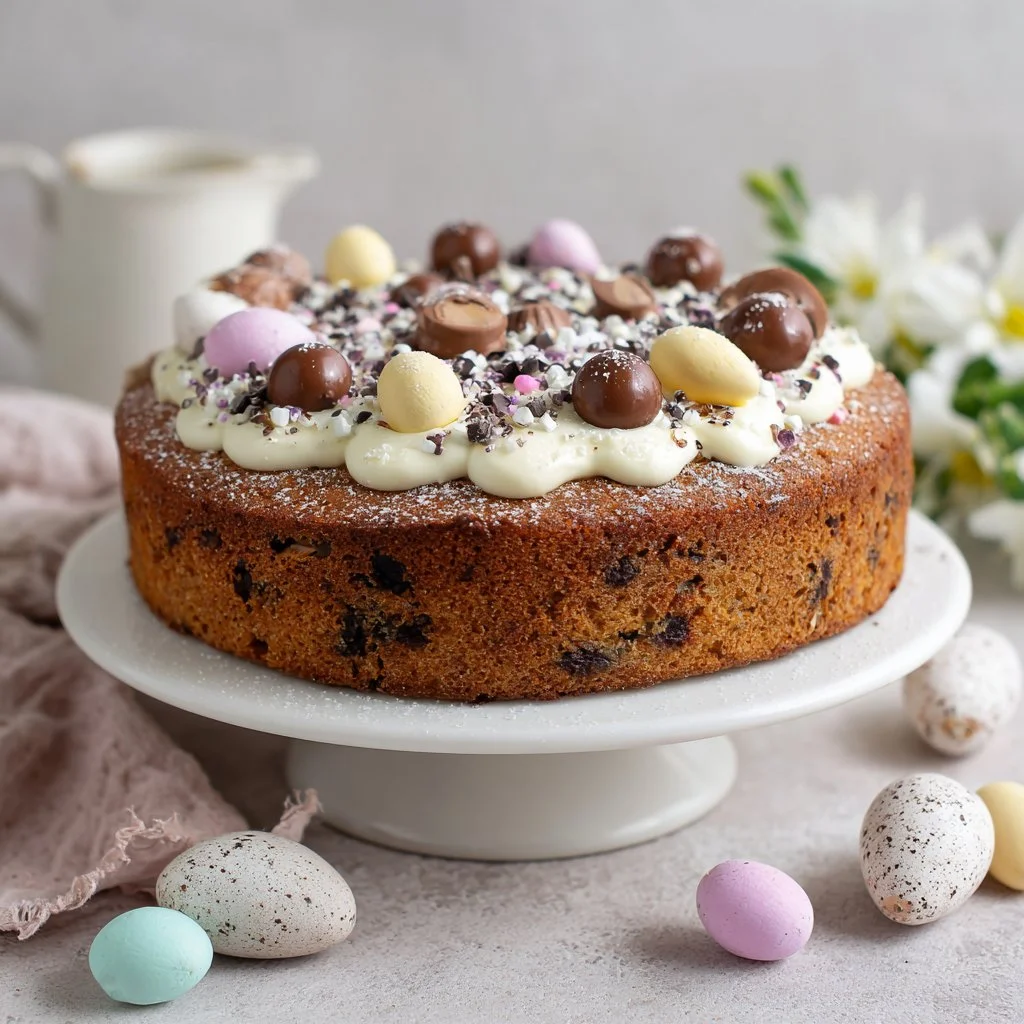
The buttercream border gives a creamy balance and provides a neat frame for the chocolate-speckled surface.
"Absolutely loved this! The center was gooey without being raw and the kids couldn’t stop piling on the mini eggs. Perfect for our Easter brunch." — 5★ reader review
Key Ingredients for Easter Chocolate Cookie Cake
Unsalted butter (115 g melted + 75 g room temp for buttercream).
Butter is the fat backbone that controls spread and chew. Use European-style butter if you want a slightly richer flavor. Substituting with margarine changes flavor and can make the cookie flatter; if using salted butter, reduce added salt slightly.
For more about ingredient handling check our cookie policy on butter and fats.
Light brown soft sugar (135 g).
Brown sugar brings moisture, caramel notes, and chew because of its molasses content. For best results scoop and level from a packed brown sugar container. Swapping for granulated sugar will yield a drier, crisper cookie with less depth of flavor.
Plain flour (275 g).
Flour provides structure; plain (all-purpose) flour creates a tender crumb when balanced with cornflour. For a cakier result you can whisk in a little extra cornflour or use cake flour, but using bread flour will make the cookie too dense and chewy. If substituting gluten-free flour, choose a 1:1 blend that contains xanthan for stability.
Milk chocolate chips/chunks (150 g).
Milk chocolate melts into pockets that remain soft but not runny, creating those signature chocolatey streaks. Use chunks for larger melted pools and chips for smaller bites. Dark chocolate will increase bitterness and reduce the candy-like sweetness.
Full Ingredient List for Easter Chocolate Cookie Cake
- 115 g unsalted butter
- 55 g white granulated sugar
- 135 g light brown soft sugar
- 1 medium/large egg
- 1 tsp vanilla extract
- 275 g plain flour
- 1 tsp bicarbonate of soda
- 1/2 tsp sea salt
- 1 tbsp cornflour
- 150 g milk chocolate chips/chunks
- 200 g Easter chocolates (mini eggs, chocolate buttons, etc.)
- 75 g unsalted butter (room temp) — for buttercream
- 150 g icing sugar — for buttercream
- 1/2 tsp vanilla extract — for buttercream
- Extra Easter chocolates and sprinkles for decoration
Step-by-Step Instructions for Easter Chocolate Cookie Cake
Step 1: Preheat and prepare the tin
Preheat your oven to 180ºC (160ºC fan) and line an 8″/20cm round tin with parchment paper.
Pro Tip: The paper should come just up the sides for easy removal; the tin should feel warm to the touch when oven is ready.
Step 2: Melt the butter and whisk with sugars
In a large bowl, melt 115 g unsalted butter. Add 55 g granulated sugar and 135 g light brown soft sugar, then whisk for about 2 minutes until smooth and homogenous.
Pro Tip: The mixture should look glossy and slightly frothy from whisking.
Step 3: Add the egg and vanilla
Whisk in 1 medium/large egg and 1 tsp vanilla extract until fully combined and smooth.
Pro Tip: The batter should thicken slightly and smell of vanilla; no streaks of egg should remain.
Step 4: Fold in the dry ingredients
Sift or add 275 g plain flour, 1 tsp bicarbonate of soda, 1/2 tsp sea salt, and 1 tbsp cornflour. Fold gently until a dough forms; do not overmix.
Pro Tip: Dough should look cohesive, slightly sticky but able to be pressed; no loose flour pockets.
Step 5: Mix in chocolates
Stir in 150 g milk chocolate chips/chunks and 200 g Easter chocolates. Distribute evenly throughout the dough.
Pro Tip: You should see chocolate flecks and candy pieces spread through the dough; some candies may start to soften.
Step 6: Press the dough into the tin
Press the cookie dough evenly into the bottom of the prepared tin, smoothing the top with a spatula or the back of a spoon.
Pro Tip: The surface should be level and compacted, about 1–1.5 cm thick in the pan.
Step 7: Bake the cookie cake
Bake for 25–27 minutes until the top looks dry and set. The cookie should not wobble when you tap the tin.
Pro Tip: The edge will be golden-brown and the center should look matte (not wet).
Step 8: Cool in the tin
Allow the cookie cake to cool in the tin for 30 minutes to set and finish baking from residual heat.
Pro Tip: The cake will release slightly from the tin edges and the center will feel firm to the touch.
Step 9: Transfer to a wire rack
Lift the parchment and transfer the cookie to a wire rack to cool completely before adding buttercream.
Pro Tip: The bottom should be fully cool — warm cake will melt the buttercream.
Step 10: Make the buttercream
Beat 75 g room-temperature unsalted butter for 2 minutes until smooth. Add 150 g icing sugar and 1/2 tsp vanilla extract and beat until pale and fluffy.
Pro Tip: Buttercream should be light, airy, and pipeable; it should hold a peak but still flow slightly when scooped.
Step 11: Decorate
Pipe a border around the cooled cookie using a star tip. Arrange extra Easter chocolates and sprinkles inside the border.
Pro Tip: The piped border should have defined ridges and hold its shape when you add decorations.
For oven tweaks and cooling guidance see our cookie policy for oven tips.
Expert Tips for Easter Chocolate Cookie Cake
- Control oven heat: If your oven runs hot, lower to 170ºC/150ºC fan and watch closely between 20–30 minutes.
- Texture troubleshooting: A too-soft center means underbaked — cool longer in the tin for carry-over cooking.
- Crisp edges: Use a metal tin rather than silicone for crisper rims.
- Even spread: Chill the dough briefly if it’s overly soft before pressing into the tin.
- Buttercream temperature: Always use room-temperature butter for smooth, lump-free frosting.
- Equipment tip: A small offset spatula makes pressing and smoothing the dough easy and neat.
- Common mistakes: Overmixing flour develops gluten and makes the cake tough; fold gently.
- Visual cue: When adding candy decorations, press pieces only slightly so they remain visible after baking.
For more equipment and technique notes consult our cookie policy on tools.
Storage & Freezing for Easter Chocolate Cookie Cake
Fridge storage: Store in an airtight container for up to 4 days.
Use a shallow box or cake carrier to prevent squashing decorations.
Freezer storage: Freeze un-iced slices individually wrapped in parchment and foil for up to 3 months.
To freeze whole, wrap twice and place in a rigid box.
Thawing: Thaw slices at room temperature for 30–60 minutes.
Whole cake should defrost in the fridge overnight to prevent condensation.
Reheating: Warm a slice for 10–15 seconds in a microwave to revive gooeyness.
Avoid microwaving the whole cake; it can melt the buttercream border.
Variations & Substitutions for Easter Chocolate Cookie Cake
Chocolate peanut butter swirl:
Stir 3–4 tbsp smooth peanut butter into half the dough before pressing into the tin. The result will be pockets of nutty richness that contrast the milk chocolate.
Triple-chocolate:
Replace 50 g of milk chips with dark chocolate chunks and sprinkle white chocolate chips on top before baking. Expect deeper chocolate complexity and visual contrast.
Gluten-free option:
Use a 1:1 gluten-free flour blend with xanthan gum. Texture will be slightly crumblier, so press firmly and avoid overbaking.
Mini cookie towers:
Divide the dough among smaller tart tins and bake for 12–15 minutes for individual cookie cakes. These are crispier at the edges and perfect for single servings.
Frequently Asked Questions About Easter Chocolate Cookie Cake
Q: Can I make this cookie cake dairy-free?
A: Yes. Use a dairy-free margarine with a similar fat content for the melted and creamed butter, and choose dairy-free chocolate. Expect a slight change in flavor and a softer mouthfeel. Chill the dough briefly if it spreads too much.
Q: How do I stop the Easter chocolates from melting completely?
A: Use candies with a hard shell (mini eggs) and fold them in gently. Place a few extra whole candies on top after baking to preserve shape and color. Mixing some chocolate chips (they keep shape better) also helps.
Q: Can I make this ahead for a party?
A: Bake up to 24 hours in advance, cool completely, and pipe buttercream just before serving. Store in an airtight container at room temperature for best texture; refrigerate if your kitchen is warm.
Q: My cookie cake is dry. What went wrong?
A: Overbaking is the main cause. Reduce bake time by a few minutes and ensure you cool in the tin to allow residual heat to finish cooking. Also check that your brown sugar is fresh; stale sugar can dry baked goods.
Q: How do I get a clean slice when serving?
A: Chill the cake for 20–30 minutes to firm up the center. Use a sharp, warmed knife and wipe between slices for neat cuts.

Final Thoughts on Easter Chocolate Cookie Cake
This Easter Chocolate Cookie Cake is a fast, festive centerpiece that balances chewy cookie texture with candy-sweet bursts.
If you try it, please leave a star rating in the recipe card below and pin it to Pinterest for others to find.
For inspiration from other bakers, see an alternative take at Easter Cookie Cake – Fun for ALL Ages! – That Skinny Chick Can Bake, a colorful sibling recipe at Easy Easter Cookie Cake – Design Eat Repeat, and a sugar-cookie style version at Easter Sugar Cookie Cake – Crazy For Crust.
Easter Chocolate Cookie Cake
Ingredients
Method
- Preheat your oven to 180ºC (160ºC fan) and line an 8"/20cm round tin with parchment paper.
- In a large bowl, melt 115 g unsalted butter. Add 55 g granulated sugar and 135 g light brown soft sugar, then whisk for about 2 minutes until smooth.
- Whisk in 1 medium/large egg and 1 tsp vanilla extract until fully combined and smooth.
- Sift or add 275 g plain flour, 1 tsp bicarbonate of soda, 1/2 tsp sea salt, and 1 tbsp cornflour. Fold gently until a dough forms.
- Stir in 150 g milk chocolate chips/chunks and 200 g Easter chocolates into the dough.
- Press the cookie dough evenly into the bottom of the prepared tin, smoothing the top with a spatula.
- Bake for 25–27 minutes until the top looks dry and set.
- Allow the cookie cake to cool in the tin for 30 minutes.
- Transfer to a wire rack to cool completely.
- Beat 75 g room-temperature unsalted butter until smooth, then add 150 g icing sugar and 1/2 tsp vanilla extract and beat until fluffy.
- Pipe a border around the cooled cookie using a star tip and arrange extra Easter chocolates and sprinkles inside the border.